

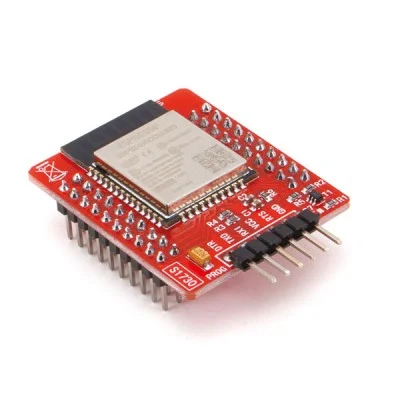
In the rapidly expanding landscape of the Internet of Things (IoT), the quest for the "holy grail" of hardware—a device that balances robust connectivity with extreme energy conservation—remains the primary driver of innovation. Espressif Systems has long been the industry standard-bearer in this regard, and their latest release, the MINIESP32LP (Low Power Module), represents a tactical shift in how engineers approach remote, battery-dependent sensing.
By stripping away unnecessary peripheral hardware, this new module challenges the conventional design philosophy of "all-in-one" development boards. Instead, it offers a streamlined, lean architecture designed specifically for deployments where every milliampere counts.
Main Facts: Stripping Back for Peak Performance
The MINIESP32LP is not merely another iteration of the ubiquitous ESP32; it is a surgical refinement. At its core, the module utilizes Espressif’s powerful System-on-Chip (SoC) architecture, maintaining full software compatibility with the standard MINI ESP32 versions. This ensures that developers currently utilizing the ESP32 ecosystem can transition to this low-power variant without refactoring their entire codebase.
The most significant design choice—and the one that defines the module’s character—is the intentional omission of the onboard USB-to-Serial interface. While this may seem like a step backward to hobbyists accustomed to "plug-and-play" development, it is a strategic decision for power-conscious engineers. On-board USB bridges (such as the CP210x or CH340) are notorious for drawing quiescent current even when the system is supposedly in a "sleep" state. By removing this interface, the MINIESP32LP eliminates the "vampire drain" inherent in standard development boards.
Key Technical Specifications:
- Connectivity: Integrated WiFi 802.11 b/g/n transceiver.
- Bluetooth: Dual-mode functionality, supporting both Classic Bluetooth and Bluetooth Low Energy (BLE).
- Compatibility: Full Arduino IDE integration, allowing for rapid prototyping using the familiar C++ based environment.
- Form Factor: Compact, space-saving design suitable for integration into tight, custom-designed enclosures.
Chronology: The Journey to the Low-Power Standard
The path to the MINIESP32LP did not happen in a vacuum. To understand its importance, one must look at the evolution of the ESP32 series over the last decade.
Phase 1: The Breakthrough (2016)
When the original ESP32 was launched, it revolutionized the market by integrating Wi-Fi and Bluetooth into a single, affordable chip. It became the backbone of the "Maker" revolution, but its power consumption—while impressive for the time—was often too high for long-term, battery-operated remote sensors.
Phase 2: The Proliferation of "Full-Featured" Boards (2017–2022)
As the ESP32 gained traction, manufacturers flooded the market with development boards loaded with extras: USB-C ports, battery charging circuits, RGB LEDs, and voltage regulators. These features made development easier but moved the hardware further away from the ideal "deep sleep" profile required for industrial field deployments.
Phase 3: The Demand for Industrial Minimalism (2023)
Industrial clients and IoT startups began requesting hardware that was stripped of these "convenience" features. They required modules that could run on a coin cell or a small LiPo battery for months, or even years, without physical intervention.

Phase 4: The Release of the MINIESP32LP (2024)
The launch of the MINIESP32LP marks the industry’s response to these specific industrial needs. By providing a professional-grade module that prioritizes power efficiency over ease-of-access, Espressif and their distributors are signaling that the market is maturing beyond simple prototyping.
Supporting Data: Why "Low Power" Matters
In the world of IoT, power consumption is the ultimate arbiter of success. For a remote moisture sensor in a vineyard or a structural health monitor in a bridge, battery replacement costs often exceed the cost of the hardware itself.
The Math of Current Leakage
Standard ESP32 development boards often exhibit a "deep sleep" current draw of several milliamperes (mA) due to the presence of power-hungry regulators and USB communication chips. In contrast, the MINIESP32LP, when implemented with a low-quiescent-current voltage regulator, can drop into the microampere (µA) range.
- Standard Development Board: ~10-20mA idle current.
- MINIESP32LP (Optimized): <10µA in deep sleep mode.
This delta is the difference between a device that dies in weeks and one that functions for years. Furthermore, the dual-mode Bluetooth (Classic + BLE) allows for a tiered communication strategy: the device can remain in deep sleep, wake up to capture data, use BLE for local configuration if a technician is present, or push data to the cloud via WiFi only when necessary.
Official Responses and Engineering Perspectives
In discussions regarding the module, lead engineers from the Open-Electronics community have emphasized that this board is "opinionated" hardware. It makes a choice on behalf of the developer: efficiency over ease.
"The MINIESP32LP is not designed for the developer who wants to plug a cable into their laptop and see ‘Hello World’ in five seconds," noted a senior firmware engineer familiar with the release. "It is designed for the developer who is looking at a power budget and realizing that every component on their PCB is a potential point of failure for battery longevity. By removing the USB bridge, we have removed a component that is only useful during the development phase and is effectively dead weight in the production phase."
The consensus among industry experts is that this module fills the gap between raw SoCs—which are difficult to solder and manage—and fully-featured dev boards, which are too power-heavy for serious deployment.
Implications: The Future of IoT Deployment
The introduction of the MINIESP32LP signals a wider trend in the electronics industry: the return to "bare-metal" efficiency. As the Internet of Things matures, we are seeing a shift away from "everything-and-the-kitchen-sink" hardware.

1. The Rise of "Prototyping to Production" Paths
The MINIESP32LP bridges the gap in the product lifecycle. Because it is fully compatible with the Arduino IDE, the prototype code developed on a standard board can be migrated to the MINIESP32LP with minimal friction. This reduces time-to-market and lowers the risk of bugs during the transition from a breadboard to a custom PCB.
2. Environmental Impact
While it may seem trivial, the reduction in power consumption across millions of IoT devices has a significant environmental footprint. Devices that stay in the field longer mean fewer batteries in landfills and less frequent site visits for maintenance, reducing the overall carbon footprint of large-scale sensor networks.
3. Cost-Effective Scaling
By omitting the USB interface and the associated support circuitry, the unit cost of the module is kept low. For companies deploying thousands of sensors, these savings accumulate rapidly. This makes the MINIESP32LP an attractive candidate for large-scale agricultural monitoring, smart city infrastructure, and environmental logging.
4. A Challenge to Hardware Design
This module challenges engineers to think about how they handle programming and debugging. Without an onboard USB port, engineers must incorporate external USB-to-TTL adapters or use specialized programming jigs during the manufacturing process. This change in workflow encourages cleaner, more professional board designs where the programming header is a dedicated, temporary interface rather than a permanent, power-wasting fixture.
Conclusion
The MINIESP32LP is a testament to the fact that sometimes, less really is more. By acknowledging the specific needs of the industrial and long-term IoT sectors, Espressif and the team at Open-Electronics have provided a vital tool for engineers who prioritize longevity and efficiency.
As we move toward a future where billions of devices are connected to the network, the focus must shift from how many features we can pack into a chip to how sustainably we can operate those chips. The MINIESP32LP is a significant, albeit quiet, step in that direction. It is a tool for the pragmatic professional—a module that asks for less power so that it can do much more work.
For those ready to move past the "blinking LED" phase of development and into the world of professional, long-term, field-deployed IoT, this module is not just an option; it is an essential piece of the puzzle.